Many gardeners think of spring bulbs as something that should be purchased every few years. This is only true for some spring bulbs. British gardeners purchasing tulip bulbs discover that under British garden circumstances, tulips are not reliably perennial. British summers are not warm nor dry enough for tulip bulbs to ripen, which leads to tulips in gardens becoming less and less vigorous over the seasons and, eventually, ceasing to flower. Buying tulips as an annual expense is about the nature of the plant from the British climate, not about failing the gardening techniques.
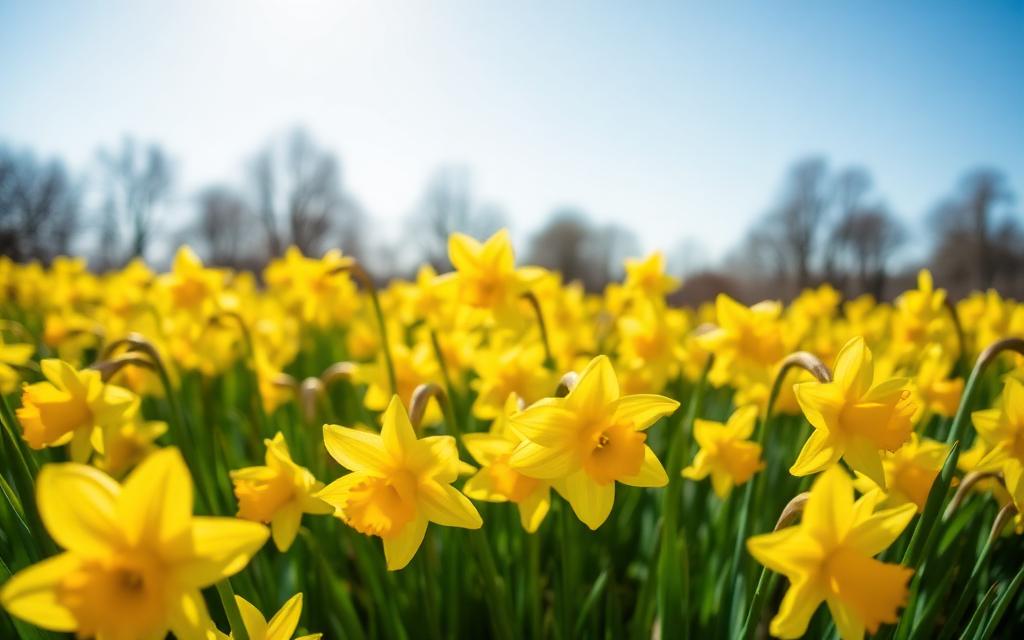
In British gardens, daffodils are a different case. In these gardens, most narcissi naturalize themselves and keep on flowering as long as their site has a moderate drainage and is in the full sun or even partial shade. Naturalizing narcissi increase in number continuously. The main, and the most important, factor is the moderate drainage. If narcissi bulbs are submerged in excess water, their bulbs rot due to a lack of oxygen. This explains the rapid decline in the number of flowering daffodils that thrived for a few seasons and then did not return. This condition can be adapted to by planting on a slope or amending clay with horticultural grit.
Naturalising bulbs in grass may seem simple, but making the effort initially will offer the greatest rewards in the long run. Although scattering bulbs and planting them where they fall creates an authentic planted look, it often leads to awkward concentrations and bare areas where the scattering is uneven. For the quickest, natural looking result, bulbs should be arranged in a drift style, closer in the center, and spread at the edges. Only cut the grass after the bulb’s foliage has died back. For daffodils, for example, cutting should be after a six week period following flowering. If cutting is done early, then the bulbs’ output is noticeably weakened for the following years.
Of the two bulbs, Camassia and Fritillaria meleagris, these particular bulbs should be considered decorative naturalised grass for an informal meadow orchard bulb planting. Both bulbs are damp, and the infiltrated mildly fertile loose soil works well for traditional orchard water-meadow settings. Flowering occurs at the end of April and the beginning of May. This offers a prolonged flowering period compared to the flowering period of daffodils. Fritillaria meleagris is a native flowering bulb for traditional British water meadows. This bulb works well in informal planted settings, contrasted to bulbs of a more exotic nature.
The bulbs least suited to naturalizing are those that should be removed each year for summer storage. While bulbs like dahlia and gladiolus are easy to grow, and tulip and other similar bulbs grow almost anywhere in Britain, the commitment of doing the extra work of lifting, drying, and replanting each year is considerable. It’s a large commitment with large planting that may dishearten many. Selecting bulbs that keep their space in the ground and regrow successfully, is more pleasing for the gardener and garden.